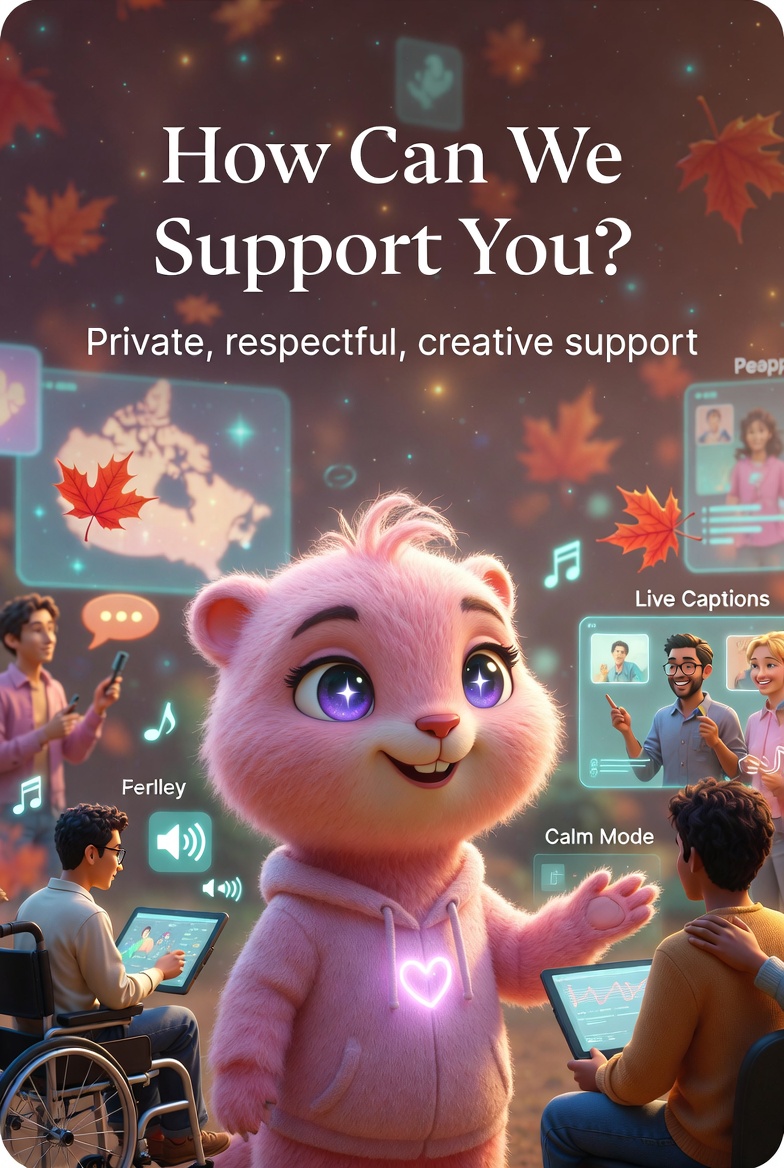
Sparky the Beaver
Friendly AI-literacy guide
Explains how AI works, asks questions, invites reflection
Safety boundary: Never claims to be human, conscious, or an authority
PROPOSED PILOT · NOT YET OPERATING
Fredericton Holograms helps people learn, create, question, and participate in AI—safely, accessibly, and together.
FrederictonHolograms.com can become a Community AI Safety Bridge: a small, accessible holographic learning station where people create with AI, question it, protect their privacy and culture, and earn through local creative work.
It responds to real museum-sector problems (limited staff capacity, funding pressure, digital gaps and low collection visibility) without claiming that holograms solve them. It is a staff-supported learning and interpretation tool, not an AI that replaces museum staff.
Published survey figures, shown as reported. They describe the sector; they are not results of this project.
REPORTED UNESCO–ICOM 2026
REPORTED UNESCO–ICOM 2026
REPORTED UNESCO–ICOM 2026
REPORTED Ithaka S+R 2025
REPORTED Ithaka S+R 2025
REPORTED Ithaka S+R 2025
REPORTED Ithaka S+R 2025
REPORTED Ithaka S+R 2025
REPORTED Ithaka S+R 2025
REPORTED Ithaka S+R 2025
REPORTED Ithaka S+R 2025
A compact, disability-led holographic exhibit and workshop system for museums, libraries, schools, tourism sites, and community centres. It combines:
Fictional guides, not impersonations of real people, unless explicit permission, consent and cultural authority are in place.
Friendly AI-literacy guide
Explains how AI works, asks questions, invites reflection
Safety boundary: Never claims to be human, conscious, or an authority
Local-history guide
Helps visitors explore Fredericton and New Brunswick stories
Safety boundary: Clearly fictional; historical claims link to sources
Inclusion guide
Offers plain-language, captioned, and alternative-format support
Safety boundary: Does not diagnose, advise medically, or replace human support
Creative collaborator
Helps visitors make stories, images, or exhibit ideas
Safety boundary: Labels AI output; protects visitor ownership and privacy
Critical-thinking guide
Helps visitors identify bias, errors, and missing context
Safety boundary: Encourages verification; does not present AI output as fact
Key rule: every character says, in plain language, that it is an AI character, not a real person, and that visitors should verify important information.
Visitors ask a safe, pre-approved question about a local exhibit, artifact, or historical theme. The character gives a short answer, shows a source or uncertainty label, and invites the visitor to check the museum label or ask staff.
“Sparky, what might this object have been used for?”
Learning goal: AI can help explore, but humans and sources remain important.
The character gives a short local-history explanation containing one deliberate, clearly marked error. Visitors find it using exhibit labels, QR codes, or staff support.
Learning goal: AI can be wrong; verification is a skill.
Visitors create a short story, poem, exhibit title, or visual concept inspired by an artifact. The result is labelled AI-assisted, consent is asked before saving or displaying it, and visitors can delete their input.
Learning goal: AI is a creative tool, not an autonomous authority.
Visitors learn what they should and should not share with an AI system: personal information, location, passwords, images of other people, and sensitive family or health details.
“What should I never tell an AI character?”
Learning goal: Privacy is part of AI literacy.
Visitors test whether an exhibit explanation works for different needs: large text, captions, audio description, plain language, and screen-reader-friendly QR content.
Learning goal: Accessible design benefits everyone.
| Museum problem | FrederictonHolograms solution | Measurable outcome |
|---|---|---|
| Funding pressure | Modular rental, workshop, tourism, and sponsorship model | Revenue per activation; sponsor leads |
| Staff capacity | Character handles repeat questions; staff remain in control | Staff time saved; visitor questions answered |
| Low collection visibility | Brings less-displayed artifacts and stories into interactive experiences | Objects featured; visitor engagement |
| Digital-capability gap | Provides ready-made, accessible AI learning activities | Staff trained; sessions delivered |
| AI governance gap | Built-in consent, privacy, source labels, and escalation rules | Policy adopted; incidents logged |
| Visitor engagement | Interactive, localized, participatory experiences | Dwell time; repeat visits; feedback |
| Accessibility | Plain language, captions, audio, tactile supports, quiet options | Accessibility satisfaction; accommodation requests met |
| Community relevance | Local co-design and cultural-content review | Community partners involved; content approvals |
Every station displays and enforces these rules.
Pilot name: Fredericton Safe AI Learning Station. No host has been confirmed yet.
| Role | Responsibility |
|---|---|
| FrederictonHolograms | Provide system, characters, training, maintenance, and reporting |
| Host venue | Provide space, staff time, visitor access, and local context |
| Community co-designers | Review stories, language, accessibility, and cultural accuracy |
| Accessibility advisors | Test interaction paths and recommend improvements |
| Museum staff | Approve content, supervise sessions, and handle escalations |
| Participants | Use the system, give feedback, and decide whether to save creations |
Pricing hypotheses to test during the pilot. No revenue or attendance is promised.
| Offer | Customer | Price approach | Revenue purpose |
|---|---|---|---|
| Pilot installation | Museum, library, tourism site | One-time setup fee | Hardware, content, integration |
| Monthly station licence | Venue | Monthly subscription | Software, updates, support |
| School workshop | Schools and community groups | Per-session fee | Facilitation and materials |
| Tourism activation | Hotels, festivals, visitor centres | Per-event or seasonal fee | Visitor engagement |
| Sponsorship | Local businesses and funders | Sponsorship package | Accessibility and community access |
| Custom character module | Museum, municipality, cultural organization | Project fee | Local story and exhibit integration |
| Staff training | Museums and libraries | Workshop fee | AI literacy and safe-use training |
Only what the pilot can realistically measure. Targets are examples, not results.
| Metric | Example target | Why it matters |
|---|---|---|
| Sessions completed | 30 in 90 days | Tests basic demand |
| Unique participants | 150 in 90 days | Tests reach |
| Accessibility satisfaction | At least 80% positive | Tests inclusive design |
| Staff-rated usefulness | At least 70% positive | Tests operational fit |
| Content accuracy issues | Zero unresolved critical issues | Tests safety and quality |
| Consent compliance | 100% | Tests privacy practice |
| Visitor-created works saved | Optional and consent-based | Tests creative engagement |
| Repeat visitors | Track only if privacy-compliant | Tests return engagement |
| Cost per session | Calculate after pilot | Tests financial viability |
| Sponsor or partner leads | 3 qualified conversations | Tests partnership potential |
An illustrative comparison of a sector-wide safe-AI capacity effort against no plan. Only the 2026 values are reported data; every later value is an assumption, not a forecast.
A single Fredericton pilot cannot move these sector-wide figures on its own. The “with plan” line shows a target direction that many organisations would have to share. It should be read as a goal to test, not an expected result.
AI staff training, % of museums, 2026–2036. The 2026 starting value is reported; every later point is an illustrative assumption.
| Year | Without plan | With plan (target) | Gap |
|---|---|---|---|
| 2026 | 17.0% | 17.0% | 0.0 pp |
| 2027 | 19.0% | 24.0% | +5.0 pp |
| 2028 | 21.0% | 31.0% | +10.0 pp |
| 2029 | 23.0% | 38.0% | +15.0 pp |
| 2030 | 25.0% | 45.0% | +20.0 pp |
| 2031 | 27.0% | 52.0% | +25.0 pp |
| 2032 | 29.0% | 59.0% | +30.0 pp |
| 2033 | 31.0% | 66.0% | +35.0 pp |
| 2034 | 33.0% | 73.0% | +40.0 pp |
| 2035 | 35.0% | 80.0% | +45.0 pp |
| 2036 | 37.0% | 87.0% | +50.0 pp |
FrederictonHolograms Safe AI Learning Station

FrederictonHolograms proposes a small, accessible holographic AI learning station for museums, libraries, schools, and community spaces.

The station uses friendly fictional AI characters to help visitors explore local history, create with AI, learn about privacy, and practise checking AI-generated information. It is designed to support staff, not replace them.

The system includes safe-learning activities, accessibility features, consent controls, source labels, and a simple evaluation process. Characters are clearly fictional and do not impersonate real people without permission and appropriate cultural authority.

We are seeking one local pilot partner to test the concept over 90 days. The pilot would measure visitor engagement, accessibility, staff usefulness, content accuracy, privacy compliance, and operational feasibility.

This is not a claim that holograms or AI will solve museum funding or staffing challenges. It is a practical, community-centred pilot to test whether accessible AI learning can support museums, tourism, education, and creative participation in Fredericton.
## Safe AI Learning Characters

FrederictonHolograms is developing accessible holographic AI learning experiences for museums, libraries, schools, and community spaces.

Our approach uses clearly fictional characters to help people:

- Explore local history and culture
- Learn how AI works and where it can fail
- Create stories, images, and ideas with AI
- Protect privacy and personal information
- Practise checking information before trusting it
- Participate in accessible creative learning

### Our safety approach

AI characters are clearly labelled as fictional. They do not claim to be human, conscious, or an authority. Visitors can stop, skip, repeat, or exit at any time.

We do not require personal accounts. We do not save visitor creations, images, voice recordings, or stories without clear consent.

Important historical and scientific information is linked to sources, museum labels, archives, or staff-reviewed materials. Human staff remain available for questions, concerns, and accessibility support.

### Accessibility

The experience is designed for diverse cognitive and physical needs. It includes plain language, captions, large-text options, audio alternatives, quiet-mode settings, and clear ways to ask for help.

### Pilot invitation

We are seeking one Fredericton museum, library, school, tourism site, or community organization to host a 90-day Safe AI Learning Station pilot.

The pilot will test visitor engagement, accessibility, staff usefulness, content accuracy, privacy compliance, and operational feasibility.
This is not a national-scale solution or a proven educational intervention. It is a Fredericton-first pilot that can be tested, improved, and expanded only if it shows real value for museums, visitors, staff, and community partners.
Propose a host venue