Spark AI NLP Research
Spark AI Matrix
Scientific Architecture & Epistemic Assurance Blueprint
A dual-tier framework: formal epistemic research on the front end, backed by deterministic benchmarks and open hardware specifications. Every figure on this page carries a provenance tag.
Section 1
Epistemic Assurance Layer & Formal Logic
Neural generation is decoupled from state execution by an invariant verification gate, so the system refuses rather than guesses.
- Fail-Closed Execution Engine: when state verification fails, incomplete claims are suppressed rather than approximated.
- Evidence Passports: every numeric claim carries provenance metadata.
Claimvalid ⇔ Hash(Claim Data) ≡ PassportSignature - Tri-State Claim Tagging: [MEASURED] [REPORTED] (e.g. Statistics Canada, IMF) [SYNTHETIC]
Evidence Passports & Truth Schema
GATE PASSES
[MEASURED] · [REPORTED] · [SYNTHETIC]
GATE FAILS
Refuse to guess · Suppress output · Hand off to human lead
Section 2
OES-512 Deep-Space Protocol & Benchmarks
OES-512 models distributed telemetry over non-negligible light-time delays, verifying state consensus across asymmetric channels.
One-way light-time thresholds
[REPORTED]- Moon
- ≈ 1.3 s
- Mars
- ≈ 3–22 min
- Outer planets
- ≥ hours
Residual telemetry scoring formula
[SYNTHETIC]S = 0.45·Peak + 0.35·RMS + 0.20·MeanLatching condition: a block latches if and only if S ≥ τ, with τ = 0.50.
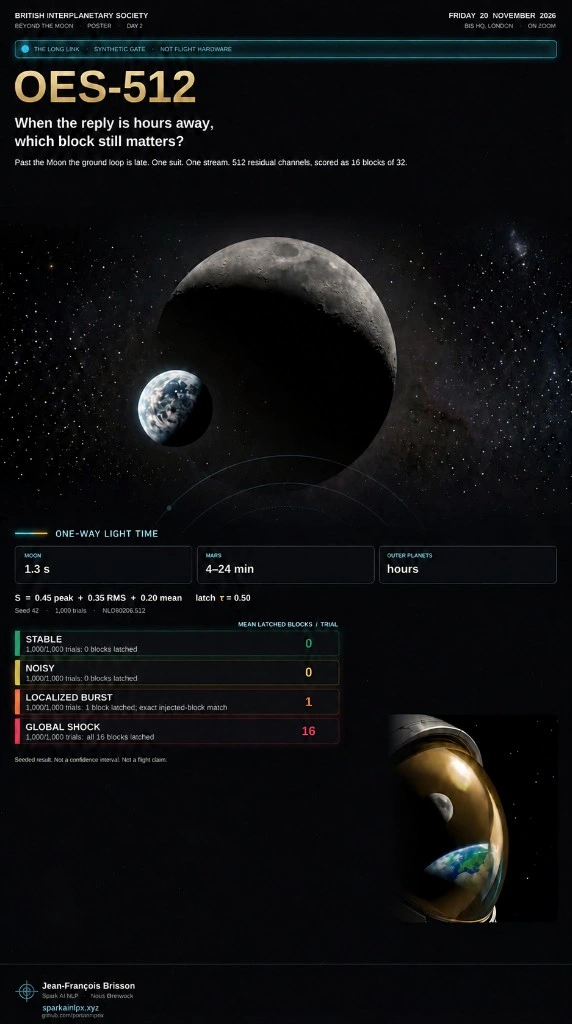
POSTER · THE LONG LINK · SYNTHETIC GATE · NOT FLIGHT HARDWARE
When the reply is hours away, which block still matters?
Past the Moon, the ground loop is late. One suit, one stream: 512 residual channels are scored as 16 blocks of 32, so that the crew-side system can decide locally which block must latch, without waiting for Earth.
Seed 42 · 1,000 trials. Seeded result — not a confidence interval, not a flight claim. [SYNTHETIC]
Benchmark results (N = 1,000 seeded Monte Carlo trials)
[SYNTHETIC]| Trial mode | Injected failure state | Mean latched blocks / trial | Latch integrity rate |
|---|---|---|---|
| Stable Channel | Baseline white noise | 0 / 16 blocks | 100% (1,000/1,000) |
| Noisy Channel | SNR < 6 dB | 0 / 16 blocks | 100% (1,000/1,000) |
| Localized Burst | Targeted block noise injection | 1 / 16 blocks | Exact block match (1,000/1,000) |
| Global Shock | Total carrier interruption | 16 / 16 blocks | Full failsafe latch (1,000/1,000) |
Simulation results. Reproduce them with oes512-telemetry-engine on GitHub.
Section 3 · Special Focus
HoloWorldBridge (HWB-Mesh)
A proposed low-latency spatial telepresence architecture connecting AI Community Centers through persistence-of-vision (POV) holographic fans and spatial depth arrays.
Node A
opt-in evidence stream
Node B
Spatial Optical Sync
[SYNTHETIC]Multi-blade POV LED fan arrays (> 120 fps refresh, design target) with dynamic depth compensation to prevent visual stutter and strobe interference.
Dual-Stream Protocol
[SYNTHETIC]Stream α: low-overhead VP9/AV1 WebRTC display payload synced to audio and speech. Stream β: Evidence Passport validation and safety-state exchange.
Hardware Safety Envelopes
[SYNTHETIC]Microcontrollers designed to cut motor power within 12 ms (design target, not yet bench-measured) of sensor obstruction, optical fault or emergency-button trigger.
Section 4
[SYNTHETIC]Physical Envelope & Microgrid Calculations
Reproducible solar and battery sizing across two latitudes for continuous, independent power of one field unit.
Daily electrical load
2,540 Wh/day
Offline-first AI edge unit + 4-blade hologram array + audio
Battery storage
5.9 kWh
LiFePO₄, nominal 80% depth of discharge
Derived autonomy
≈ 1.9 days
5.9 kWh × 0.80 = 4.72 kWh usable ÷ 2.54 kWh/day
Location A: Fredericton, NB, Canada
45.96° N, 66.64° W
- Winter peak tilt angle
- 43°
- December solar yield
- 2.48 kWh/kWp/day
- PV array sizing
- 1.09 kWp (monocrystalline)
Location B: Marrakech, Morocco
31.62° N, 7.98° W
- Optimal annual tilt angle
- 32°
- Annual solar yield
- 4.59 kWh/kWp/day
- PV array sizing
- 0.76 kWp (monocrystalline)
Internal-consistency check. Load ÷ (yield × kWp) gives the implied system derate: 2.54 ÷ (2.48 × 1.09) ≈ 0.94 for Fredericton but 2.54 ÷ (4.59 × 0.76) ≈ 0.73 for Marrakech. The two sizes use different loss assumptions. Under one common derate of 0.75, Fredericton would need ≈ 1.37 kWp (Marrakech ≈ 0.74 kWp). The sizing will be revised and tested against field data (plan Stage 5).
Section 5
Phygital Economic Lifecycle & Rollout Timeline
- 01Community-led co-design
- 02Safe-learning modules
- 03Real-world job creation
- 04Global web & tourism hub
- 05Verified local revenue
- 06Community reinvestment
Step 06 feeds back into step 01. The loop is closed.
Phased deployment gate matrix (proposed)
Assurance Gate
100% of safety interlocks and passports valid
Pilot Feasibility
1 community test: 3 lessons, 1 event, 10-point NFC
The Gate (Outcomes)
Strict positive margin over local baseline metrics
Public Scale
Independent external review and verified registry
Section 6
Citations & Repositories
DOI status for this blueprint: pending. Following the fail-closed rule, no DOI is shown for it until one resolves. Related software is already archived: 22 Zenodo releases, including OES-32 Residual Reference, oes512q-latch and the OES-Resilience benchmark. See all DOIs and live demos.
CITATION.cff
cff-version: 1.2.0
message: "If you use the Spark AI Matrix framework or OES-512 benchmarks, please cite as below."
authors:
  - family-names: "Brisson"
    given-names: "Jean-François"
    affiliation: "Spark AI NLP Research & Nous Brewrock"
title: "Spark AI Matrix: Epistemic Assurance Layer, OES-512 Protocol, and HoloWorldBridge Architecture"
version: 1.0.0
# doi: added after the first Zenodo release mints it
date-released: 2026-11-01
url: "https://www.sparkainlpx.xyz"
repository-code: "https://github.com/sparkainlp-x/spark-ai-matrix-canada"
keywords:
  - "epistemic engineering"
  - "fail-closed systems"
  - "spatial telepresence"
  - "holographic displays"
  - "deep space telemetry"
Repository archival structure
sparkainlp-x/
├── .github/workflows/
│   ├── test-simulation.yml   # Deterministic pytest for OES-512 Monte Carlo runs
│   └── zenodo-release.yml    # Automated DOI minting webhook
├── CITATION.cff              # Standardized academic attribution metadata
├── LICENSE                   # Apache 2.0 / MIT
├── README.md                 # Architecture whitepaper overview & live badges
├── docs/
│   ├── epistemic-framework.pdf
│   ├── holoworldbridge-mesh.pdf
│   └── solar-sizing-fredericton-marrakech.csv
└── src/
    ├── epistemic_gate/  (passports.py, fail_closed.py)
    └── telepresence/    (hwb_mesh.py)
Open repositories
Section 7 · For PhD reviewers
Methods, Validity & Reproducibility
This section is written for doctoral-level reviewers. It states what is tested and what is not, the hypotheses we intend to test, the main threats to validity, and the reporting standards we commit to. This is engineering and social-science research only, with no medical or health claims.
Research plan · six staged studies
Each stage has a clear exit criterion. A stage that fails its criterion stops the dependent stages (fail-closed). No dates are promised until the previous stage passes.
- STAGE 1 · H1
Replicate OES-512
Re-run the benchmark across many seeds, sweep τ and the weights, fix channel normalisation, and pre-register the analysis on OSF before running.
Exit criterion: Results and code public; the headline result holds across seeds or the claim is withdrawn.
- STAGE 2 · Hardware
Bench-test the safety envelope
Measure refresh rate and motor cut-off time on a real POV fan rig with calibrated instruments, repeated trials and an open log.
Exit criterion: Measured values published with uncertainty; targets met or revised.
- STAGE 3 · H2
Evaluate the epistemic gate
Paired, blinded comparison of gated vs ungated model output on a fixed question set, scored by two or more independent annotators.
Exit criterion: Fewer unsupported claims at an over-refusal rate set in advance, with agreement κ reported.
- STAGE 4 · H3
Co-design study
Telepresence sessions co-designed with disabled co-researchers; usability scales plus interviews. Starts only after research ethics board approval.
Exit criterion: REB approval obtained; findings reported in full, including negative ones.
- STAGE 5 · H4
Winter field log
Run one field unit through a Fredericton winter and log energy in, energy out and battery state of charge.
Exit criterion: Logged data matches the sizing model, or the model is corrected.
- STAGE 6 · Gate 4
External review & archive
Independent replication by an outside group, Zenodo release with DOI, and submission to a peer-reviewed venue.
Exit criterion: DOI resolves and an independent group has reproduced the main result.
Falsifiable hypotheses
| ID | Claim under test | How it would be tested | Current status |
|---|---|---|---|
| H1OES-512 | Under localized-burst injection, the latch rule flags exactly the injected block and no others. | Multi-seed sweep (many seeds, not seed 42 only); report false-positive and false-negative block counts; sweep τ to give a full operating curve. | Single seed run |
| H2Epistemic gate | A fail-closed gate lowers the rate of unsupported numeric claims compared with the same model ungated, at an acceptable over-refusal rate. | Blinded human annotation of paired outputs; report unsupported-claim rate, over-refusal rate and inter-rater agreement (Cohen’s κ). | Not yet tested |
| H3HoloWorldBridge | Co-designed telepresence sessions are experienced as accessible and dignified by disabled participants. | Mixed methods with disabled co-researchers: validated usability scales plus interviews. Research ethics board approval under TCPS 2 first. | Concept only |
| H4Microgrid | The proposed PV and battery sizing meets the stated load through a Fredericton December. | Logged field data (energy in, energy out, state of charge) over at least one winter; compare with the model. | Model only |
Threats to validity & limitations
- One seedAll OES-512 results come from seed 42. 1,000 trials under one seed do not show how stable the result is across seeds.
- Synthetic noise modelThe injected noise and failure modes have not been checked against real suit or spacecraft telemetry. The results describe the simulator, not hardware.
- Threshold choiceτ = 0.50 and the 0.45 / 0.35 / 0.20 weights are not yet justified (pre-set or tuned?). A sensitivity analysis is needed, and channel normalisation must be specified, since S depends on scale.
- Design targets, not measurementsThe > 120 fps refresh and 12 ms motor cut-off are engineering targets. No bench measurements are published yet.
- Microgrid derate mismatchThe two PV sizes imply different system derates (≈ 0.94 Fredericton vs ≈ 0.73 Marrakech). See the note in Section 4.
- No human-subject dataNo participant data exists yet. Any accessibility or experience outcome is a hypothesis, not a finding.
- IndependenceDesign, code and evaluation so far come from one author. Independent replication and external review are required before any public-scale claim (Gate 4).
Reading the 1,000 / 1,000 results
Zero failures in n = 1,000 does not mean zero risk. If the trials are independent, the exact (Clopper–Pearson) one-sided 95% upper bound on the per-trial failure probability is:
pupper = 1 − 0.051/1000 ≈ 0.30%The rule of three (3 / n) gives the same 0.30%. The bound is about the simulator under seed 42 only. It is not a hardware failure rate.
Reviewer pack status
- Source code (GitHub)Available
- CITATION.cffDrafted
- Zenodo DOIPending
- Multi-seed resultsNot yet run
- Pre-registration (OSF)Not yet filed
- Bench measurements (fps, cut-off)Not yet measured
- REB approvalNot yet sought
- Conflict-of-interest statementBelow
Reporting standards we commit to
TRIPOD+AI (2024)
Reporting for prediction / scoring models such as the S-score latch.
DECIDE-AI (2022)
Early-stage live evaluation of AI decision support with human users.
TCPS 2 (2022)
Canadian research-ethics policy for any study with people (REB review).
FAIR principles (2016)
Findable, accessible, interoperable, reusable code and data releases.
ACM artifact badges
Independent check that code is available, functional and reproduces results.
Nothing about us without us
Disabled people as co-researchers and co-authors, not only as subjects.
Conflict of interest & funding
Jean-François Brisson is the founder of Spark AI NLP and Fredericton Holograms and designed the systems on this page. No external research funding has been received for this work. Reviewers should read every claim with that in mind.
Review, replicate or co-author
We are looking for PhD researchers in AI safety, telemetry, HCI, disability studies and energy systems to try to break these claims, run independent replications, or co-supervise student projects. Credit goes to everyone who contributes.
Contact the research lead