Editor note: Status of all technical claims: Proposed / Synthetic unless otherwise marked. No operating mesh exists.
01 · World Holo Bridge · HWB-Mesh
One shared planet
Somewhere tonight, a person who has spent years at the edge of every room is waiting for a door that opens at their height, in their language, at their pace. World Holo Bridge begins there. It proposes that small, accessible community rooms meet across oceans as themselves: seen, captioned, unhurried. Every claim the system makes can be checked. Every question it cannot answer is refused, not guessed. The planet is already shared. The future of AI on it does not have to belong to one voice.
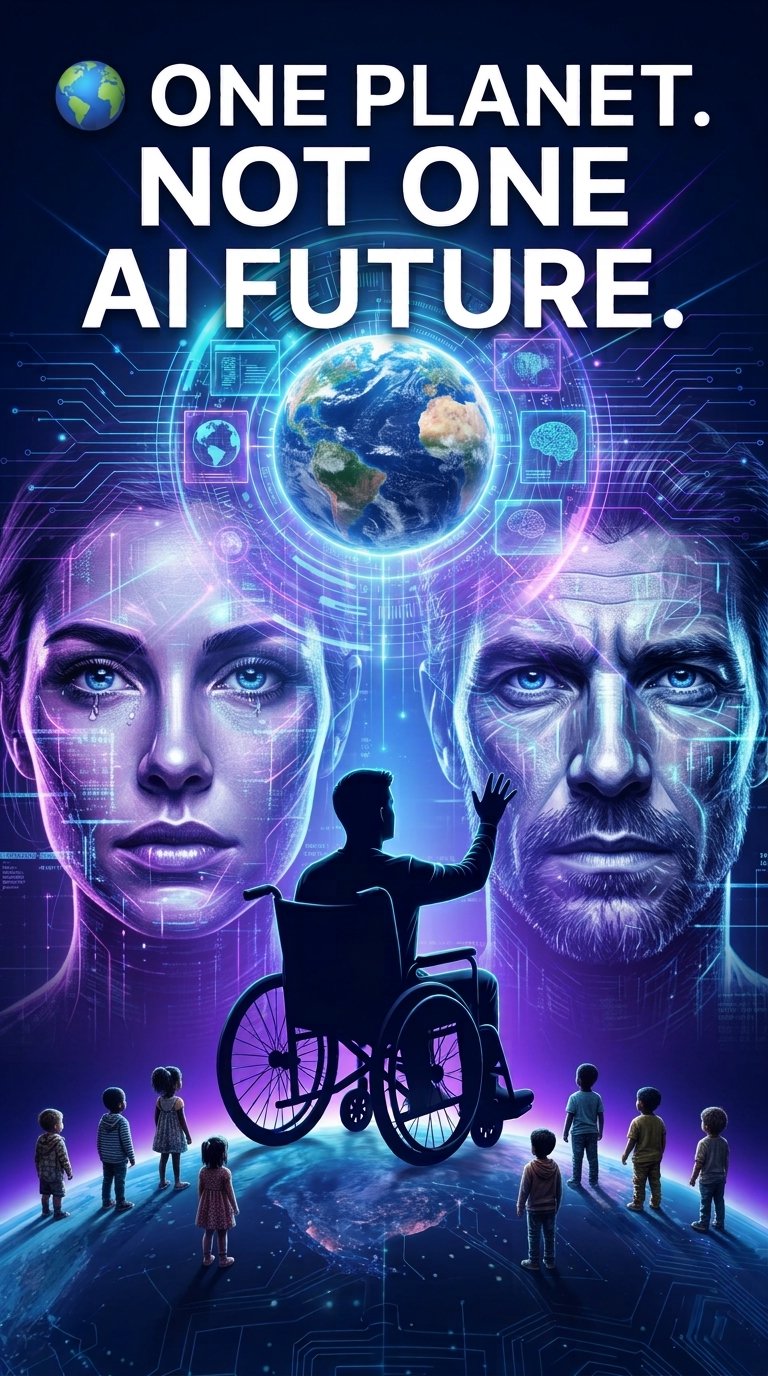
One planet. Not one AI future.
02 · Definition
What World Holo Bridge actually is
World Holo Bridge is a proposed mesh of locally owned, disability-accessible community hubs linked by holographic-style spatial telepresence. Its engineering name is HWB-Mesh.
Each hub owns its data, its schedule and its cultural decisions. The mesh carries only what a hub chooses to share.
DEFAULT, NOT ADD-ON
Local data ownership
Data stays with the hub and the person it describes.
DEFAULT, NOT ADD-ON
Cultural authority
Communities decide what is shared, with whom, and when.
DEFAULT, NOT ADD-ON
Accessibility
Live captions, calm mode, plain language and bilingual access are on before anyone asks.
No hub, link or display is operating today. [PROPOSED]
03 · The scientific heart
Two streams. Never merged.
HWB-Mesh separates presence from authority.
Stream α — Presence
The spatial and visual presence of people in the room.
- Codec target
- VP9 / AV1 [SYNTHETIC]
- End-to-end latency target
- < 15 ms [SYNTHETIC]
- Display target
- Multi-blade POV array, > 120 fps [SYNTHETIC]
Stream β — Evidence
The trust layer that travels beside the image.
- Evidence Passports accompany every claim, stating its source and status.
- Safety-state exchange lets each hub know the physical safety state of the other.
- If β is missing or unverified, the claim is withheld. Presence never carries authority; authority travels only in β.
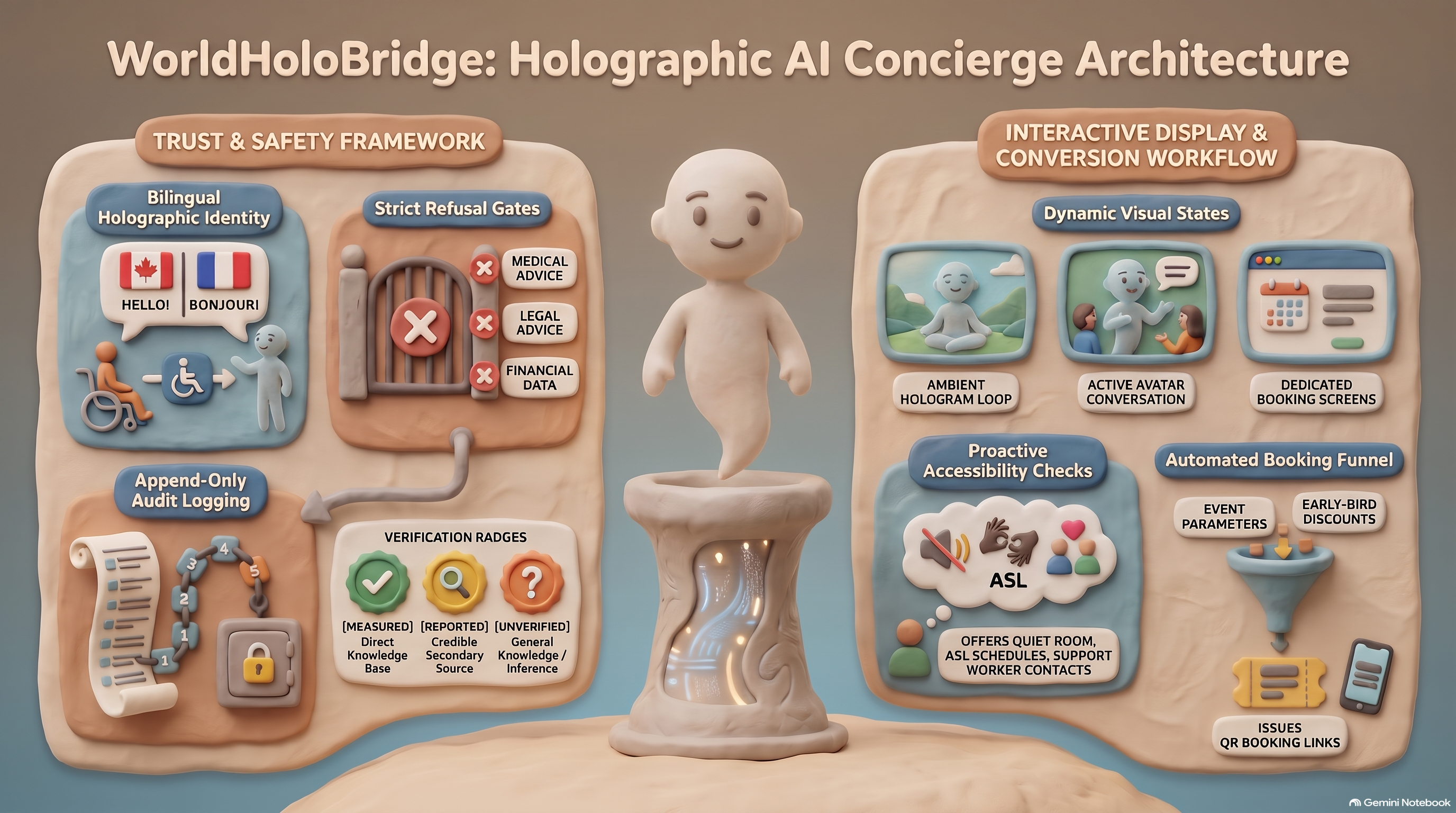
[PROPOSED] architecture · [SYNTHETIC] targets
04 · Safety, evidence, refusal
The system refuses rather than guesses.
Physical safety envelope
A dedicated microcontroller cuts power to moving display parts within 12 ms of an obstruction or E-stop. [SYNTHETIC] Design target, not a measured result.
Six governance gates
Already written as public prototype code at github.com/sparkainlp-x/world-holobridge. [PROTOTYPED]
- Gate 1ConsentNo consent, no recording, no sharing.
- Gate 2Cultural authorityWithout community authority, the story stays home.
- Gate 3AccessibilityA session that fails its access checks does not open.
- Gate 4PaymentNo hidden charges; nothing moves without explicit agreement.
- Gate 5IncidentStop, log, hand to a human.
- Gate 6Append-only auditEvery decision and every refusal is recorded and cannot be rewritten.
Refusal rules
- Unverified claim withheld and marked, never filled in.
- Medical, legal or financial question refused and referred to a qualified person.
- Missing evidence in Stream β presence continues; authority does not.
[PROTOTYPED] gates · [SYNTHETIC] timing
05 · How a hub feels
Who meets here
Not users. Not an audience. People, meeting as themselves.
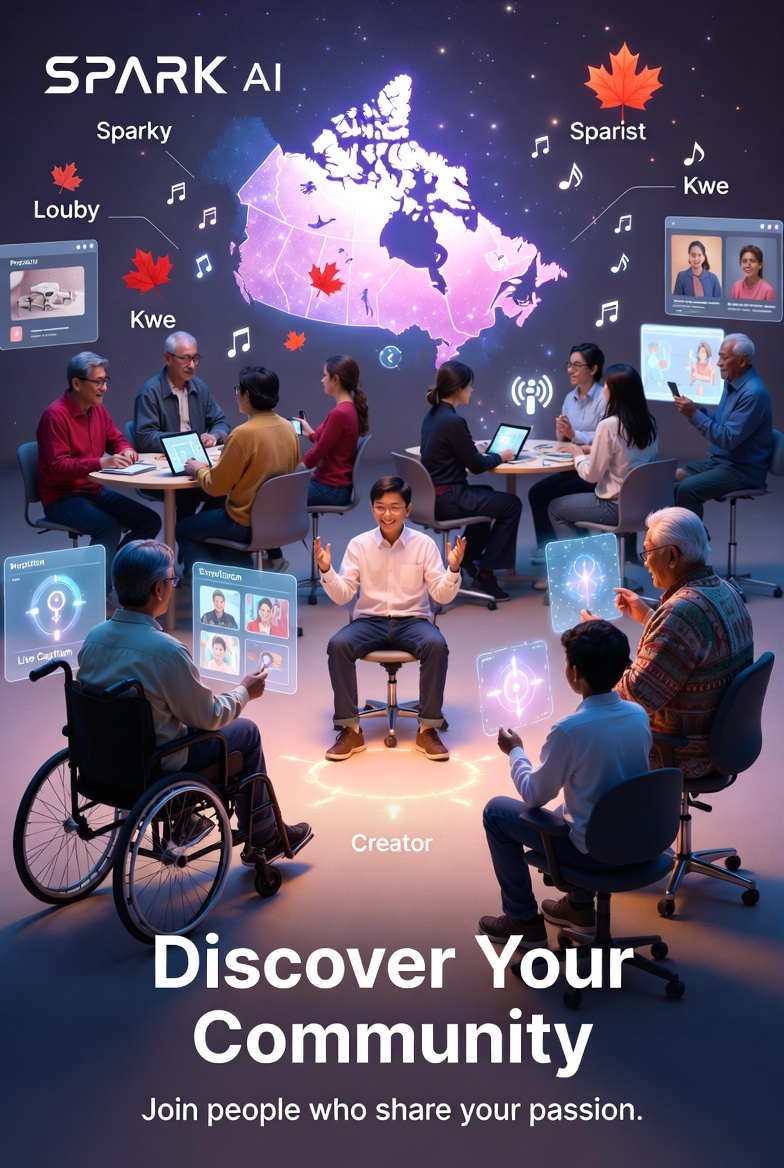
Fredericton ↔ across the Atlantic
The co-authors
A young wheelchair user in Fredericton builds a story, line by line, with an Elder on the other side of the ocean. Neither travels. Both are fully present, and the story belongs to the two of them.
Workshop lead
The Deaf artist
Her hands lead the room. Live captions carry her workshop to every hub that joins, and calm mode softens light and sound for anyone who asks. The technology adapts to her, not the other way around.
Under local cultural authority
The knowledge keeper
A First Nations knowledge keeper shares language and story only after the cultural authority gate opens on her community’s terms. What is sacred stays home. What is shared is shared by choice.
Mobile AI Hub stop
The rural parent
The nearest fixed hub is hours away, so the hub came to them. From a Mobile AI Hub stop, a rural parent and their child join the same circle as everyone else.
Quiet participation
The veteran
He sits at the edge of the room, camera off, microphone muted, and that is allowed. Adaptive creation tools let him build at his own pace. Purpose arrives quietly, not on demand.
A second country
The teenager
A character from her own culture steps into the shared holographic space, designed with her community, not for it. For the first time, the future on screen looks like home.
Illustrative vignettes.
06 · Growth model
Three gates. None skipped.
- 01Prove one hubOne Fredericton room, one display, one accessible workshop series. Safety and assurance gates pass first.
- 02Pair two hubsA second hub joins over the α / β link. Partners are named only after agreements are signed.
- 03Grow the meshOnly after independent review. No review, no growth.
Failing a gate means stopping, not scaling. Current position: before Gate 1.
[PROPOSED]07 · Physical & power layer
Power that stays local
Each hub is designed to run on its own solar microgrid, so a meeting does not depend on a distant grid or a distant owner.
| Reference design | Specification | Status |
|---|---|---|
| Fredericton, NB | 1.09 kWp PV · 5.9 kWh storage | [SYNTHETIC] |
| Marrakech | High-irradiance reference case for the same design method | [SYNTHETIC] |
Modelled examples, not installed systems. [SYNTHETIC]
08 · Two doors in
Dignity by Design and the Mobile AI Hub
Dignity by Design — the entry point
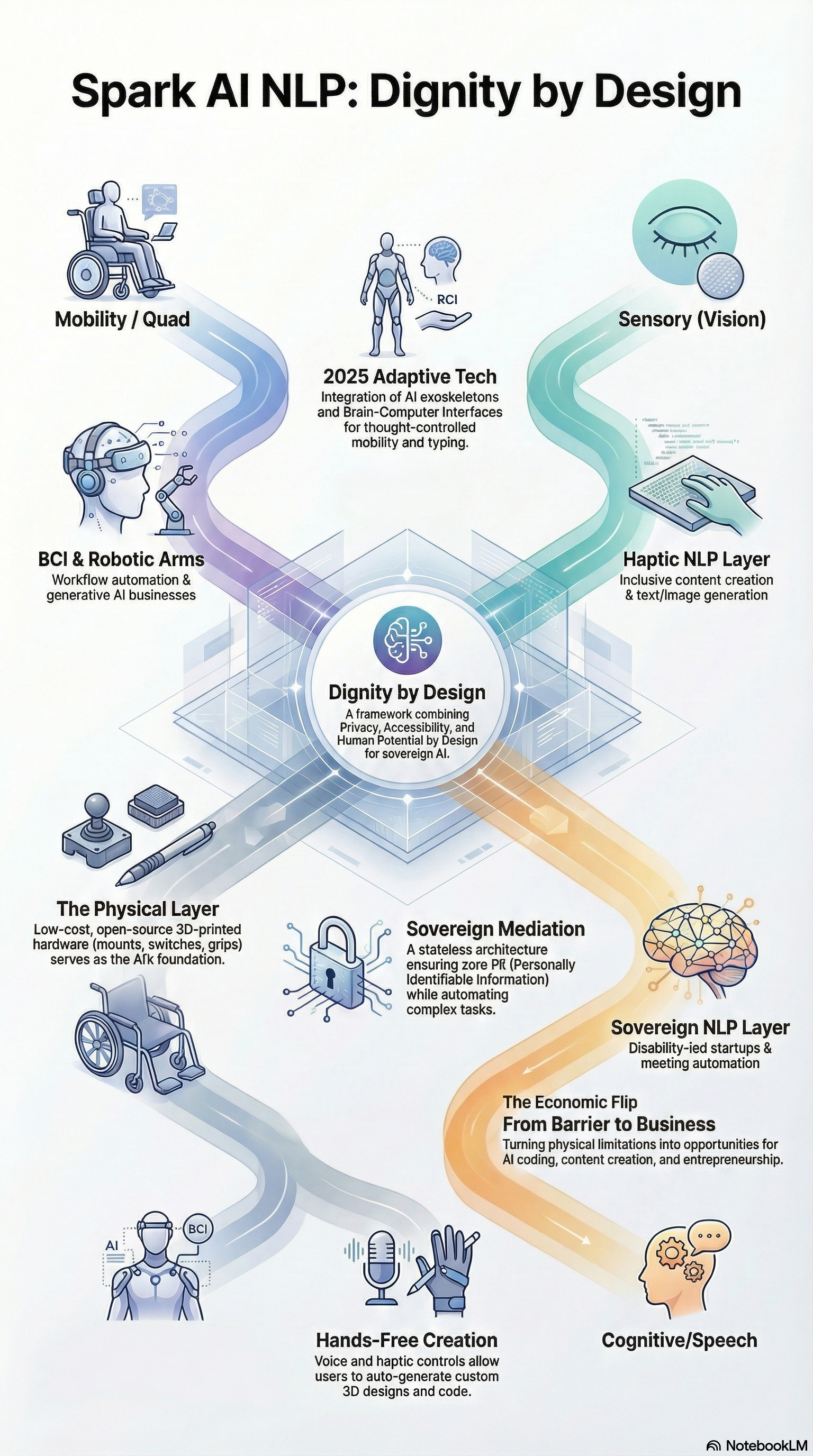
Every journey starts with a living profile: how a person wants to take part (captions, calm mode, input method), held locally and changed only by them. The Dignity by Design physical layer (adaptive mounts, switches and hands-free control) makes the first touch possible.
[PROPOSED]Mobile AI Hub — the outreach layer
Where no fixed node exists, the Mobile AI Hub brings the doorway to the community.
09 · Reality check
What exists. What is proposed.
Exists today
- Governance gate prototypes in public code[PROTOTYPED]
- HWB-Mesh interface prototype with synthetic data (below)[SYNTHETIC]
- Concept art and concept video[SYNTHETIC]
Proposed, not built
- Community hubs[PROPOSED]
- α / β dual-stream link[PROPOSED]
- Multi-blade POV display, 12 ms safety cut-off[SYNTHETIC]
- Solar microgrids, Mobile AI Hub[PROPOSED]
- Independent review of the mesh[PROPOSED]
Not yet measured: latency, frame rate, cut-off time. No operating mesh exists.
10 · An invitation
If you hold a room, a language, a story or a skill, and you believe the future should be built at human height, we would be honoured to hear from you.
Read the code. Question the targets. Propose a hub. Bring the people who are usually left outside the room. They are the reason it exists.
One planet. Not one AI future.
Country simulation · reach-weighted model
With and without the plan: a gated, reach-weighted scenario
Type a country. We load its latest real figures from the World Bank [REPORTED], then run a transparent scenario model [SYNTHETIC]. A hub does not change a national indicator on its own. Its effect is limited to the share of people it can realistically reach, serve and who actually adopt it.
Scenario model, not a forecast. No operating mesh exists. No revenue, jobs, medical or economic figures are projected.
How to read the plan effect
The plan changes an assumed growth parameter, not the national indicator directly. The extra effect is weighted by effective hub reach and adoption:
Additional effect(t) = Maximum effect × Effective hub reach(t) × Adoption(t)Example: with effective reach 10% and adoption 50%, only 5% of the maximum effect applies: 0.04 × 0.10 × 0.50 = 0.002. The internet growth parameter moves from 0.08 to 0.082, not to 0.12. Do not read this as “+4 points of internet access” or “+3 points of electricity access”.
Model assumptions [SYNTHETIC]
- Starting values: latest World Bank figure for each indicator. If a value is not reported, that indicator is not projected.
- Population: latest annual growth rate, tapering linearly to zero over 50 years.
- Baseline: internet use and electricity connection follow a logistic-style update, x + g·(cap − x)·(1 − x/cap), with g = 0.08 and 0.06, caps 95% and 100%. Renewable share +0.5 points a year, capped at 100%.
- Hub reach: years 0–1 Gate 1 (one hub, no national effect); years 2–4 Gate 2 (paired hubs, 0.5% reach); from year 5, only if the review passes, reach rises toward a maximum (central 40%) at speed 0.35.
- Effective reach = raw reach × accessibility 0.80 × affordability 0.80 × service quality 0.85 × disability inclusion 0.75.
- Adoption lag: adoption rises from the hub opening year (year 2) toward a maximum (central 50%) at speed 0.30.
- Maximum plan effects on the growth parameters: internet +0.04, electricity +0.03, renewables +0.3 points a year. These are weighted by effective reach × adoption and apply only after the review gate passes.
- Electricity connection is not the same as reliable service. Effective electricity = connection × 0.90 reliability.
- People with disabilities: outcomes = population figure × 0.85 access factor. The 16% disability share is a WHO global placeholder, not a country estimate.
- Assumption sets: Low = max reach 20%, max adoption 30%, adoption speed 0.20. Central = 40%, 50%, 0.30. High = 60%, 70%, 0.40. All other parameters are the same. These are illustrative sensitivity choices, not estimates.
- All plan parameters are illustrative assumptions for scenario discussion. They are not measured effects, forecasts or guarantees of implementation.
Claims language & how the effect would be measured
Use: “Under the stated synthetic assumptions, the gated plan scenario produces a modestly higher illustrative trajectory than the no-plan scenario. The difference depends strongly on effective hub reach, adoption, affordability, reliability, accessibility and the review-gate decision. These are scenario outputs, not measured impacts.”
Avoid: “The plan increases national internet access by 4%, electricity access by 3% and renewable energy by 0.3 points.”
Evaluation path: compare served communities with comparable non-served communities, before and after hubs open (difference-in-differences). Only measured results from that design could replace these synthetic parameters.
Spark AI HoloWorldBridge
HWB-MESH v1.0.0[SYNTHETIC] Interface prototype. No hubs are connected yet. Values shown are design specifications from the Spark AI Matrix blueprint, not live telemetry.
[ HOLOGRAPHIC PROJECTION · NODE A VIEW ]
Persistence-of-vision array · 4-blade LED system
Hub Node A (Fredericton)
45.96° N, 66.64° W · Off-grid microgrid
- PV array
- 1.09 kWp
- Solar tilt
- 43°
- Storage
- 5.9 kWh
Hub Node B (Marrakech)
31.62° N, 7.98° W · Solar reference hub
- PV array
- 0.76 kWp
- Solar tilt
- 32°
- Storage
- 5.9 kWh
PROPOSED CONCEPT · NOT YET OPERATING
World Holo Bridge
One planet. Not one AI future.
World Holo Bridge is our proposal for a network of small, accessible community hubs, starting in Fredericton, linked by holographic-style telepresence. People who are often left out of technology (disabled people, Elders, youth, rural and newcomer communities) would meet, learn and create together across distance, as themselves.
The engineering underneath is the HWB-Mesh shown above. The purpose is human: belonging, creative work, and AI that refuses to guess instead of inventing.
Community hubs, not platforms
Each node is a local, disability-accessible creative space (library, community centre, campus) that owns its own data and schedule.
Bridges between places
Hubs meet through holographic-style telepresence: workshops, storytelling and co-creation across cities, provinces and countries.
Access built in
Live captions, calm mode, plain language, French and English, quiet participation and optional intake are defaults, not add-ons.
Claims that can be checked
The β stream carries Evidence Passports. Anything unverified is withheld, and a person reviews every public claim.
How it would grow
- 01Prove one hubOne Fredericton room, one POV display, one accessible workshop series. Pass the safety and assurance gate first.
- 02Pair two hubsA second hub joins over the dual-stream link (α display, β evidence). Partners are named only once agreements are signed.
- 03Grow the meshMore hubs join only after independent review. Each one runs on its own solar microgrid design and local governance.
What a hub could feel like
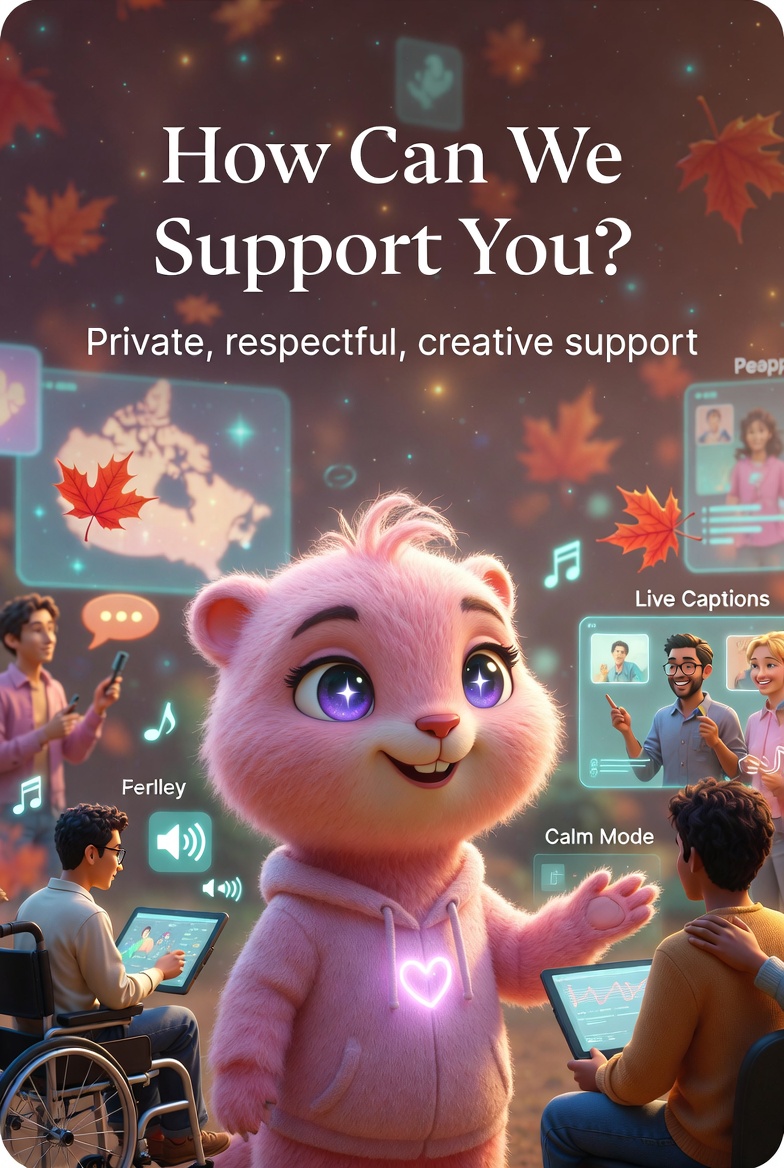
All images and video on this page are illustrative concept art. [SYNTHETIC]